Most agile teams consistently deliver exceptional results. The secret lies in understanding and applying the four core Agile values. This introduction will guide you through these fundamental principles, offering insights into how they can transform your team’s approach to project management and software development. By the end, you’ll have a clear roadmap to boost your team’s efficiency, collaboration, and adaptability in ways you never thought possible.
Before proceeding, it’s crucial to understand that Agile values and Scrum values, while connected, are not identical. Agile represents a broader philosophy with core values that shape how teams approach their work, prioritizing adaptability and customer collaboration. In contrast, Scrum is a specific framework within the Agile methodology. It builds upon Agile principles but adds its own set of values—focus, courage, openness, respect, and commitment—to help teams implement Agile practices more effectively.
The Four Core Agile Values
Agile methodologies have revolutionized project management, especially in software development. At the heart of Agile are four core values that guide teams towards more flexible, collaborative, and efficient work processes. These values prioritize human interactions, tangible results, customer input, and adaptability over rigid structures and plans. The Agile Manifesto defines four fundamental values that form the foundation of the Agile methodology, highlighting a flexible and collaborative approach to software development.
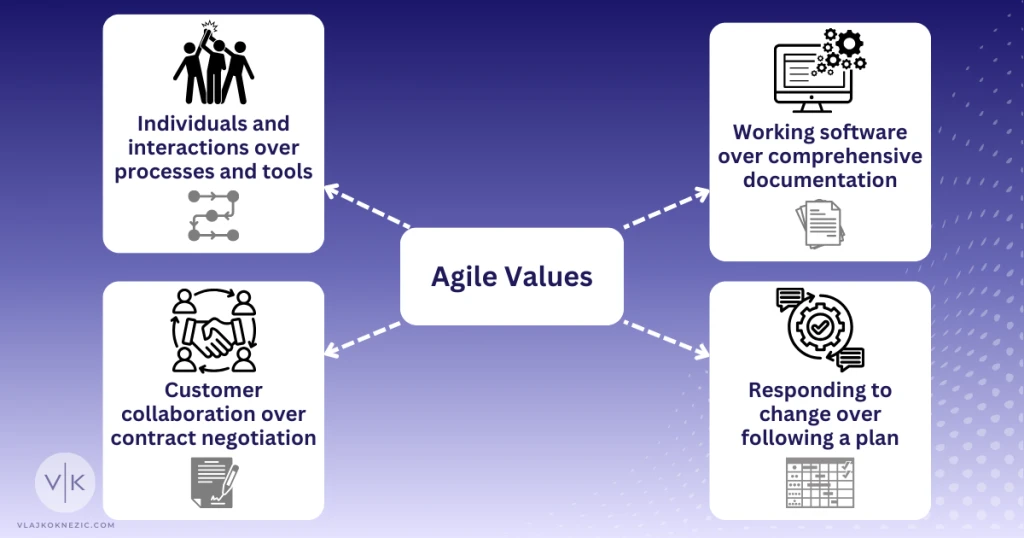
The first value emphasizes individuals and interactions over processes and tools. This doesn’t mean tools aren’t important, but rather that the people using them matter more.
The second value prioritizes working software over comprehensive documentation. While documentation has its place, the end product is what truly counts.
Customer collaboration over contract negotiation is the third value, stressing the importance of ongoing partnership rather than rigid agreements.
Finally, responding to change over following a plan highlights the Agile approach’s flexibility.
These values aren’t just theoretical concepts; they’re practical guidelines that can significantly improve project outcomes. By focusing on these core principles, teams can create more value for their customers, adapt quickly to market changes, and foster a more engaging work environment. It’s about creating a balance between structure and flexibility, documentation and action, planning and adaptation.
Individuals and interactions over processes and tools
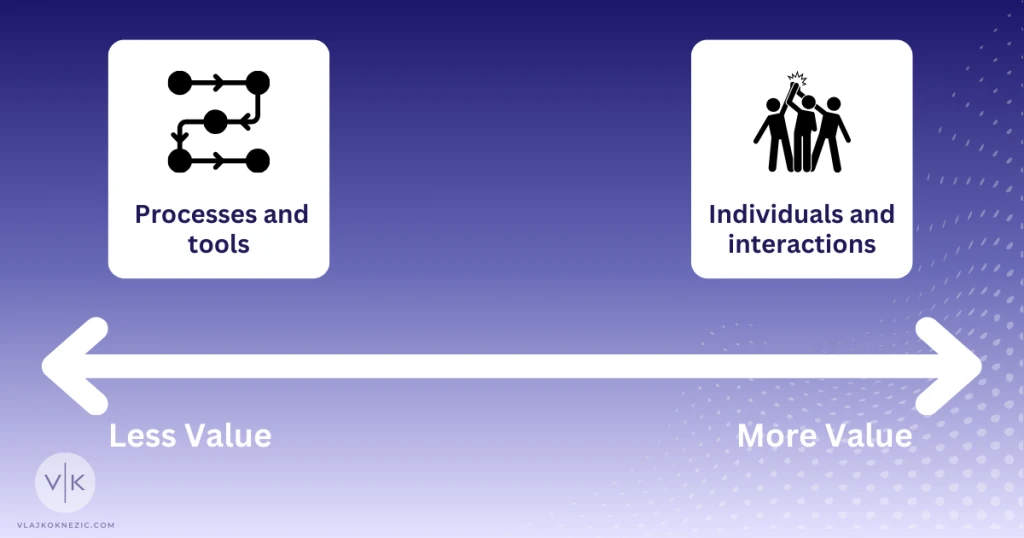
The importance of team dynamics in agile environments
In Agile environments, team dynamics play a crucial role in project success. Strong team relationships foster creativity, problem-solving, and productivity. When team members feel comfortable with each other, they’re more likely to share ideas openly and collaborate effectively. This synergy can lead to innovative solutions and faster project completion.
Teams that work well together are better equipped to handle challenges and adapt to changes. They can quickly reorganize tasks, support each other during difficult periods, and maintain a positive atmosphere even under pressure. Good team dynamics also contribute to higher job satisfaction and lower turnover rates, which can be particularly beneficial in long-term projects.
Fostering open communication and collaboration
Open communication is the lifeblood of Agile teams. It ensures that information flows freely, reducing misunderstandings and aligning everyone towards common goals. To foster open communication, teams can implement daily stand-up meetings, where members briefly share their progress, plans, and any obstacles they’re facing.
Collaboration tools can support this openness, but they shouldn’t replace face-to-face interactions. Encouraging team members to discuss issues in person or through video calls can lead to quicker resolution of problems and stronger interpersonal bonds. Creating a culture where it’s safe to ask questions, admit mistakes, and offer constructive criticism is essential for true collaboration.
Tools and techniques for improving team interactions
While personal interactions are key, certain tools and techniques can enhance team dynamics. Project management software can help track progress and assignments, ensuring everyone is on the same page. Collaboration platforms allow for easy sharing of documents and ideas, facilitating teamwork even when members are geographically dispersed.
Team-building exercises, both work-related and social, can strengthen relationships among team members. These activities can range from problem-solving workshops to casual team lunches. Regular retrospectives, where the team reflects on their processes and interactions, can also be valuable for continuous improvement.
The role of leadership in supporting individuals
Leadership plays a critical role in supporting individuals within Agile teams. Effective leaders create an environment where team members feel valued and empowered to contribute their best work. This involves recognizing individual strengths, providing opportunities for growth, and addressing conflicts constructively.
Leaders should also act as facilitators, removing obstacles that hinder team performance and ensuring that team members have the resources they need. By promoting a culture of trust and respect, leaders can help their teams achieve higher levels of collaboration and innovation. Regular one-on-one meetings with team members can help leaders stay attuned to individual needs and concerns.
Working software over comprehensive documentation
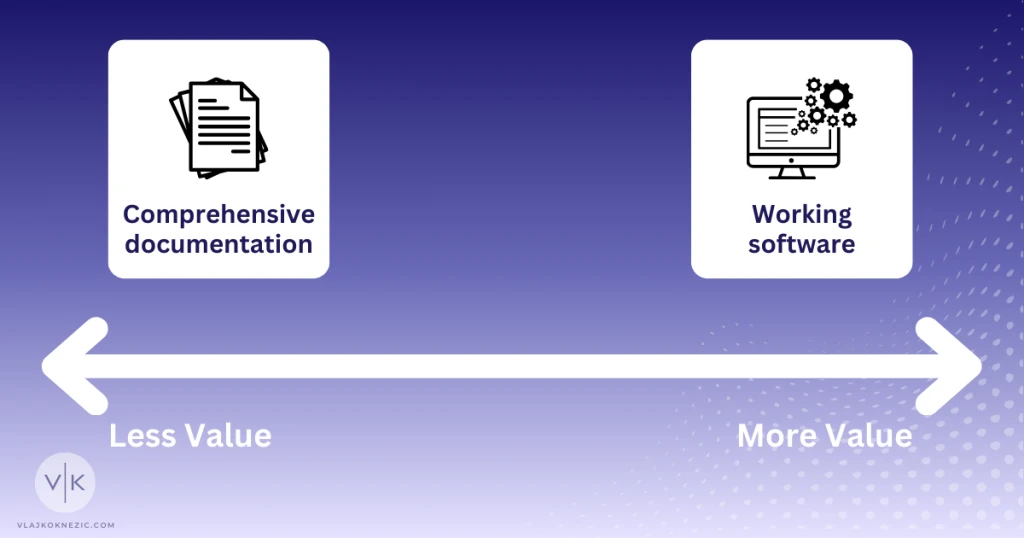
Prioritizing functional products over extensive paperwork
In Agile methodologies, the focus is on creating functional, working software rather than getting bogged down in extensive documentation. This approach allows teams to deliver value to customers faster and more frequently. Instead of spending months on detailed specifications, Agile teams work in short iterations, producing working features that can be tested and refined.
This doesn’t mean documentation is ignored entirely. Rather, it’s created on an as-needed basis, focusing on essential information that supports development and maintenance. By prioritizing working software, teams can get feedback earlier, identify issues faster, and make necessary adjustments more efficiently.
Iterative development and continuous delivery
Iterative development is a cornerstone of Agile methodologies. It involves breaking down the project into small, manageable chunks that can be completed in short time frames, typically 1-4 weeks. Each iteration results in a potentially shippable product increment, allowing for frequent releases and continuous delivery of value to customers.
This approach has several benefits. It reduces risk by allowing early detection and correction of issues. It provides opportunities for regular feedback, ensuring the product aligns with user needs. Continuous delivery also keeps the team motivated by providing a sense of accomplishment with each completed iteration.
Balancing quality and speed in software creation
While Agile emphasizes speed and flexibility, it doesn’t compromise on quality. In fact, Agile practices often lead to higher quality software due to continuous testing and integration. Automated testing, code reviews, and pair programming are some techniques used to maintain high standards while working at a rapid pace.
The key is to find the right balance between speed and quality. This often involves prioritizing features, focusing on the most critical functionalities first, and continuously refining and improving the product based on feedback. By integrating quality assurance throughout the development process, rather than leaving it to the end, teams can maintain high standards without sacrificing speed.
Measuring success through working features
In Agile projects, success is measured not by the amount of documentation produced or the adherence to initial plans, but by the delivery of working features that provide value to users. This shift in focus aligns development efforts more closely with business objectives and user needs.
Teams can track their progress using metrics such as velocity (the amount of work completed in each iteration), burndown charts (showing work remaining over time), and customer satisfaction scores. By focusing on these tangible outcomes, teams can demonstrate their progress more effectively and make data-driven decisions about project direction.
Customer collaboration over contract negotiation
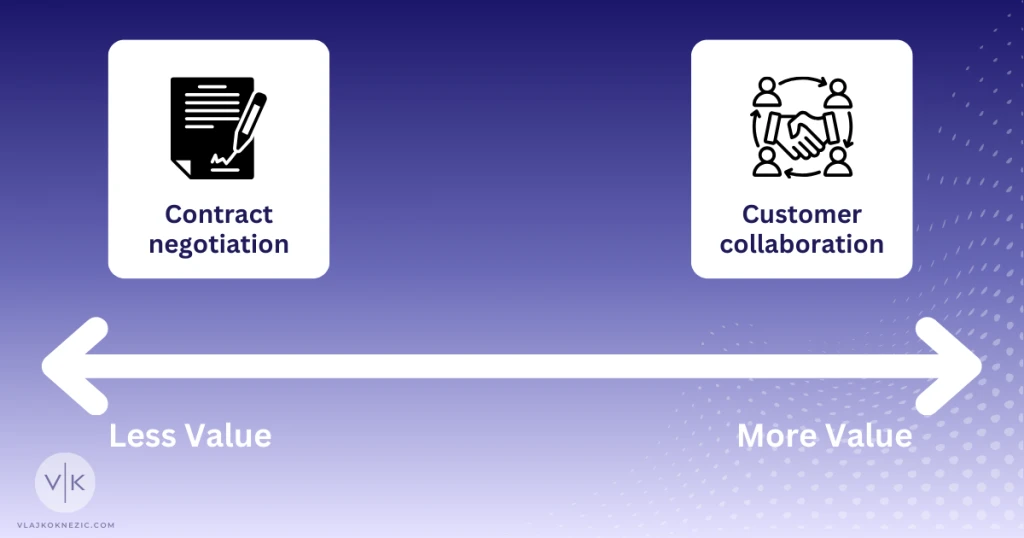
Building strong relationships with clients and stakeholders
Strong relationships with clients and stakeholders are fundamental to Agile projects. Unlike traditional project management approaches where client interaction might be limited to the beginning and end of a project, Agile methodologies promote ongoing collaboration throughout the development process.
Building these relationships requires regular communication, transparency, and a willingness to listen and adapt. It’s about creating a partnership where both the development team and the client work together towards a common goal. This collaborative approach helps ensure that the final product meets the client’s needs and expectations.
Involving customers in the development process
Agile methodologies actively involve customers in the development process. This involvement can take various forms, such as participating in sprint planning meetings, reviewing product increments at the end of each iteration, or even being part of the daily stand-ups.
By involving customers, teams can get immediate feedback on their work, clarify requirements, and make necessary adjustments quickly. This ongoing interaction helps prevent misunderstandings and ensures that the product evolves in line with the customer’s vision. It also gives customers a sense of ownership over the project, increasing their satisfaction with the final product.
Gathering and implementing feedback effectively
Effective feedback gathering and implementation is crucial in Agile projects. Teams need to establish clear channels for receiving feedback, whether through regular review meetings, user testing sessions, or online feedback tools. The key is to make it easy for customers to provide their input and for the team to capture and act on it.
Once feedback is received, it needs to be prioritized and incorporated into the development process. This might involve adjusting the product backlog, refining user stories, or making changes to existing features. The ability to quickly respond to feedback is one of the main advantages of Agile methodologies, allowing products to evolve and improve continuously.
Adapting to changing customer needs and expectations
Customer needs and expectations can change over the course of a project. Market conditions shift, new technologies emerge, or users might simply change their minds about what they want. Agile methodologies are designed to handle these changes effectively.
By working in short iterations and maintaining open lines of communication with customers, Agile teams can quickly adapt to changing requirements. This flexibility allows projects to stay aligned with customer needs, even as those needs evolve. It’s about striking a balance between delivering on agreed-upon features and being open to necessary changes that add value to the product.
Responding to change over following a plan
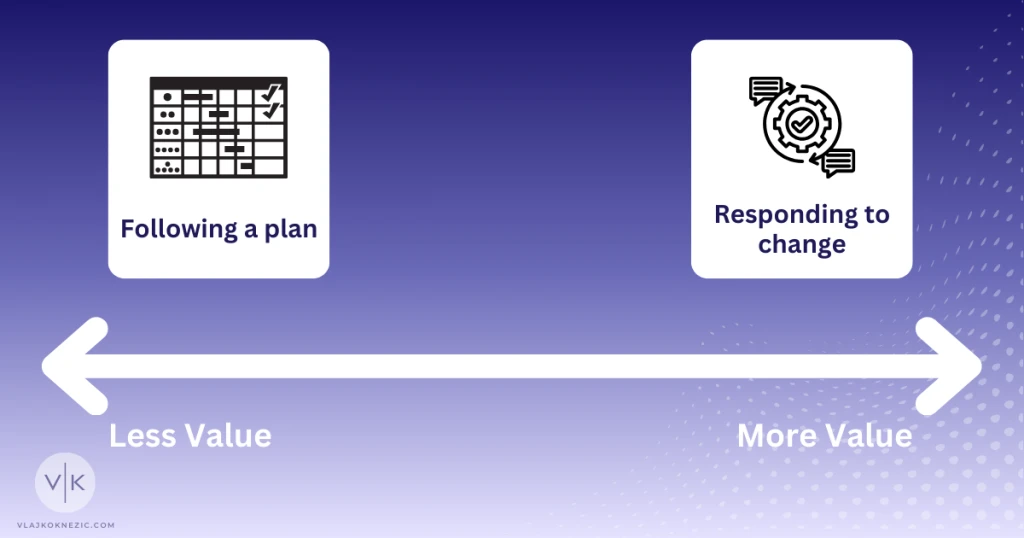
The flexibility of agile approaches in handling change
Agile methodologies are inherently designed to handle change effectively. Unlike traditional project management approaches that resist changes once a plan is set, Agile welcomes change as an opportunity to improve the product and deliver more value to customers.
This flexibility is built into the iterative nature of Agile development. By working in short sprints and regularly reassessing priorities, teams can easily incorporate new requirements or shift direction as needed. This approach allows projects to remain responsive to market conditions, technological advancements, and evolving customer needs.
Strategies for managing scope and requirements shifts
Managing changes in scope and requirements is a key skill in Agile projects. One effective strategy is to maintain a prioritized product backlog. As new requirements emerge or priorities shift, items in the backlog can be reordered, added, or removed as necessary.
Another useful technique is the use of timeboxed iterations. By limiting work to fixed time periods, teams can more easily accommodate changes without derailing the entire project. If a new high-priority requirement emerges, it can be scheduled for the next iteration, allowing the current work to be completed as planned.
Tools for tracking and implementing changes
Various tools can help Agile teams track and implement changes effectively. Project management software with features like Kanban boards or Scrum boards can visually represent work items and their progress. These tools make it easy to move tasks around as priorities change.
Version control systems are essential for managing changes in code. They allow teams to track modifications, revert to previous versions if needed, and collaborate on changes without conflicts. Issue tracking tools can help manage bug reports and feature requests, ensuring that no change requests fall through the cracks.
Balancing stability and adaptability in projects
While Agile methodologies embrace change, it’s also important to maintain some level of stability in projects. Constant changes can lead to scope creep, missed deadlines, and team burnout. The key is to find the right balance between adaptability and stability.
One way to achieve this balance is through proper sprint planning. By committing to a set of tasks for each sprint, teams create a stable work environment for short periods while still allowing for changes between sprints. Another approach is to establish a change control process for mid-sprint changes, ensuring that only truly critical changes are implemented immediately.
Implementing Agile Values in Your Organization
Steps to introduce agile values to your team
Introducing Agile values to your team requires a thoughtful approach. Start by educating your team about Agile principles and their benefits. This can be done through workshops, training sessions, or by bringing in experienced Agile coaches. It’s important to explain how these values align with the organization’s goals and how they can improve work processes.
Next, begin implementing Agile practices gradually. Start with simple techniques like daily stand-up meetings or using a visual task board. As the team becomes more comfortable, you can introduce more complex Agile methodologies. Remember, the goal is to adopt the Agile mindset, not just the practices.
Encourage open communication and collaboration from the beginning. Create opportunities for team members to share their thoughts and concerns about the transition. This openness will help build trust and buy-in from the team.
Overcoming common challenges in adopting agile principles
Adopting Agile principles often comes with challenges. One common issue is resistance to change from team members or stakeholders who are comfortable with traditional methods. To overcome this, focus on demonstrating early wins and the tangible benefits of Agile practices.
Another challenge can be maintaining consistency in Agile practices across different teams or departments. Establishing an Agile Center of Excellence or appointing Agile champions can help ensure consistent application of Agile principles throughout the organization.
Balancing Agile flexibility with organizational planning and reporting needs can also be tricky. Work with management to develop Agile-friendly metrics and reporting methods that provide necessary oversight without compromising Agile values.
Training and resources for agile transformation
Providing adequate training and resources is crucial for a successful Agile transformation. Invest in Agile training programs for all team members, not just developers or project managers. This could include formal certification courses, in-house workshops, or online learning platforms.
Create a library of Agile resources, including books, articles, and case studies, that team members can access. Encourage attendance at Agile conferences or meetups to learn from others’ experiences and stay updated on best practices.
Consider bringing in experienced Agile coaches, especially in the early stages of transformation. These experts can provide hands-on guidance, help troubleshoot issues, and accelerate the learning process for your team.
Measuring the impact of agile values on project success
To justify the investment in Agile transformation, it’s important to measure its impact on project success. Start by establishing baseline metrics before implementing Agile practices. These could include project delivery times, customer satisfaction scores, defect rates, or team productivity measures.
After implementing Agile practices, regularly track these same metrics to identify improvements. Look for trends over time rather than focusing on short-term fluctuations. Also, consider qualitative measures such as team morale and stakeholder feedback.
Use Agile-specific metrics like sprint burndown charts, velocity, and release burnup charts to track progress and identify areas for improvement. Remember that the goal is continuous improvement, so use these measurements as learning tools rather than strict performance evaluators.
To wrap up, Agile methodology prioritizes people, functioning products, customer input, and adaptability. These core values guide teams to create better software more efficiently. By focusing on teamwork, delivering working features, collaborating with clients, and being flexible to change, organizations can significantly improve their project outcomes and overall productivity.