Scrum values are the heartbeat of successful Agile projects, driving teams to achieve remarkable results. In this guide, we’ll uncover the five core Scrum values and show you how to apply them effectively in your organization. By the end, you’ll have the knowledge and tools to create a high-performing Scrum team that confidently tackles challenges and delivers outstanding results.
Before going any further, it’s important to recognize that Scrum values and Agile values are not exactly the same things. They are related but not the same. Agile is a broader philosophy with core values that guide how teams approach work, emphasizing adaptability and customer collaboration. Scrum, on the other hand, is a specific framework within Agile that builds on those principles but introduces its own set of values (focus, courage, openness, respect, and commitment) designed to guide teams in implementing Agile practices effectively.
What Are the Scrum Values?
Scrum values are the guiding principles that shape the behavior and interactions of teams working within the Scrum framework. These values – commitment, courage, focus, openness, and respect – form the ethical foundation of Scrum practices. They were introduced to provide a moral compass for teams as they navigate the complexities of project management.
The Scrum values originated from the need to create a cohesive and effective work environment in software development. They support the Agile framework by promoting adaptability, collaboration, and continuous improvement. By adhering to these values, teams can better handle the uncertainties and challenges that often arise in complex projects.
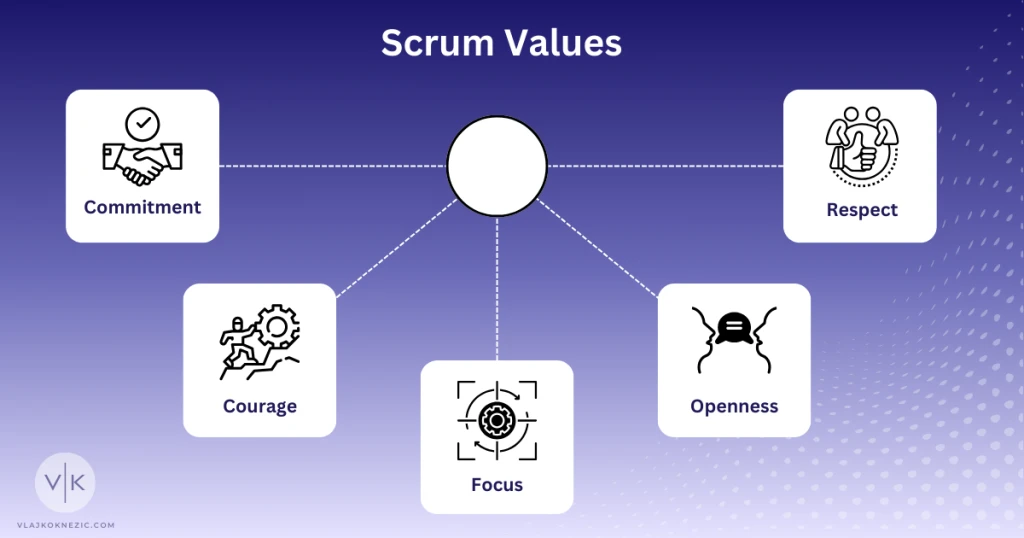
In practice, Scrum values help teams make decisions that align with the overall goals of the project and the organization. They foster a culture of trust and accountability, which are essential for the success of self-organizing teams. When applied consistently, these values can lead to higher productivity, improved quality of work, and increased job satisfaction among team members.
Commitment: The Foundation of Scrum Success
“Commitment is what transforms a promise into reality.”
Abraham lincoln
Understanding commitment in the Scrum context
In Scrum, commitment goes beyond simply agreeing to complete tasks. It involves a deep dedication to the team’s goals and a willingness to put in the effort needed to achieve them. This value encourages team members to take ownership of their work and support each other in meeting sprint objectives.
Committed teams are more likely to deliver high-quality work on time and within budget. They’re also better equipped to handle setbacks and obstacles that may arise during the project. Fostering a sense of shared responsibility and commitment helps create a positive and productive work environment.
Benefits of team commitment
When team members are truly committed, several benefits emerge. First, there’s increased trust among team members, as everyone knows they can rely on each other to follow through on their promises. This trust leads to better collaboration and more effective problem-solving.
Committed teams also tend to be more innovative. They’re willing to take calculated risks and experiment with new approaches to improve their processes and outcomes.
Additionally, commitment often results in higher job satisfaction, as team members feel a sense of purpose and accomplishment in their work.
Practical ways to foster commitment in Scrum teams
- Start by clearly communicating the project’s vision and goals. Ensure that everyone understands how their individual contributions fit into the bigger picture. Encourage team members to participate in sprint planning and goal-setting to increase their sense of ownership.
- Create an environment where team members feel safe to voice their concerns and ideas. This can be done through regular team-building activities and open discussions.
- Recognize and celebrate small wins along the way to maintain motivation and reinforce the value of commitment.
- Finally, lead by example. As a Scrum Master or Product Owner, demonstrate your own commitment to the team’s success through your actions and decisions. Your dedication will inspire others to follow suit.
Courage: Empowering Teams to Face Challenges
“Success is not final, failure is not fatal: it is the courage to continue that counts.”
winston s churchill
The role of courage in Scrum
Courage in Scrum is about facing difficult situations head-on and making tough decisions when necessary. It involves being honest about progress, admitting mistakes, and asking for help when needed. Courageous teams are more likely to innovate and find creative solutions to complex problems.
This value empowers team members to speak up when they see issues or opportunities for improvement. It also encourages them to take calculated risks and step out of their comfort zones to deliver better results. Courage is essential for maintaining transparency and addressing conflicts constructively.
Examples of courage in Scrum practices
Courage is displayed in various Scrum practices. During sprint reviews, team members show courage by presenting their work honestly, even if it’s not perfect. In sprint retrospectives, courage is needed to provide constructive feedback and suggest changes to improve team performance.
Another example is when a team member admits they are struggling with a task and asks for help. This takes courage but ultimately benefits the entire team. Similarly, having the courage to challenge unrealistic expectations or push back against scope creep demonstrates a commitment to maintaining the integrity of the sprint and the project as a whole.
Techniques for building courage within the team
To foster courage in your Scrum team:
- Create a psychologically safe environment where team members feel comfortable taking risks and sharing their thoughts. Encourage open communication and make it clear that mistakes are opportunities for learning rather than reasons for punishment.
- Provide opportunities for team members to stretch their skills and take on new challenges. Support them in these endeavors and celebrate their efforts, regardless of the outcome.
- Regularly acknowledge acts of courage within the team to reinforce its importance.
- Consider implementing pair programming or other collaborative techniques that allow team members to support each other as they tackle difficult tasks. This shared responsibility can make it easier for individuals to step out of their comfort zones.
Focus: Maximizing Productivity and Efficiency
“Concentrate all your thoughts upon the work in hand. The sun’s rays do not burn until brought to a focus.”
alexander graham bell
Importance of focus in Scrum projects
Focus is a critical value in Scrum that helps teams maintain their productivity and efficiency throughout the project. By concentrating on the most important tasks and avoiding distractions, teams can deliver high-quality work within the sprint timeframe. Focus allows team members to dive deep into complex problems and come up with innovative solutions.
In the context of Scrum, focus means prioritizing the sprint backlog and working on one item at a time. This approach helps prevent multitasking, which can lead to decreased productivity and quality. By maintaining focus, teams can better estimate their capacity and make realistic commitments during sprint planning.
Strategies for maintaining focus during sprints
- To help your team stay focused, start each sprint with a clear and well-defined sprint goal. This gives the team a common purpose to rally around. Break down complex tasks into smaller, manageable pieces that can be completed within a day or two. This makes progress more visible and helps maintain momentum.
- Implement timeboxing techniques, such as the Pomodoro Technique, to help team members concentrate on specific tasks for set periods. Encourage the use of “Do Not Disturb” signals or dedicated focus time to minimize interruptions. Regular stand-up meetings can also help keep everyone aligned and focused on the sprint goals.
- Consider using visual management tools like Kanban boards to make work progress visible and help team members stay focused on their current tasks. Limit work in progress (WIP) to prevent team members from spreading themselves too thin across multiple tasks.
Overcoming common distractions in Agile environments
Agile environments can be full of potential distractions, from impromptu meetings to constant email notifications. To combat these, establish clear communication protocols that respect focus time. For example, use asynchronous communication tools for non-urgent matters and set specific times for checking and responding to messages.
Minimize context switching by grouping similar tasks together and allocating dedicated time for them. Encourage team members to create a distraction-free workspace, whether in the office or when working remotely. This might involve using noise-canceling headphones or setting up a dedicated work area.
Address external interruptions by designating a “buffer” person who can handle urgent requests without disturbing the rest of the team. Regularly review and adjust your team’s processes to identify and eliminate sources of distraction. Remember, maintaining focus is an ongoing effort that requires commitment from the entire team.
Openness: Promoting Transparency and Trust
“Openness, transparency—these are the keystones of a collaborative culture.”
richard branson
The significance of openness in Scrum
Openness is a fundamental value in Scrum that promotes transparency and builds trust within the team and with stakeholders. It involves being honest about progress, challenges, and potential roadblocks. Open teams are more likely to collaborate effectively and find innovative solutions to problems.
This value encourages team members to share information freely, ask questions, and offer help when needed. By fostering an open environment, teams can quickly identify and address issues before they become major obstacles. Openness also helps in managing expectations with stakeholders by providing clear and accurate information about project status.
Building a culture of transparency
To create a culture of transparency, start by leading by example. As a Scrum Master or Product Owner, be open about your own challenges and mistakes. This will encourage others to do the same. Regularly share project information, including progress, risks, and decisions, with the entire team and relevant stakeholders.
Encourage team members to speak up during sprint planning, daily stand-ups, and retrospectives. Create an environment where all ideas and concerns are welcomed and discussed respectfully. Use visual management tools to make work progress and obstacles visible to everyone.
Implement regular feedback sessions where team members can give and receive constructive feedback. This helps build trust and improves communication within the team. Celebrate instances of openness to reinforce its importance in your Scrum culture.
Tools and techniques for fostering openness
Several tools and techniques can help foster openness in your Scrum team.
- Use ‘information radiators’ like burn-down charts and task boards to make project progress visible to everyone. Implement a “no-blame” policy to encourage team members to report issues without fear of repercussions.
- Consider using techniques like “fist of five” voting during decision-making processes to ensure everyone’s opinion is heard.
- Encourage pair programming or mob programming sessions to promote knowledge sharing and open communication.
- Regular retrospectives are an excellent opportunity to practice openness. Use techniques like “Start, Stop, Continue” or “Sailboat” to encourage honest feedback about team processes and interactions.
Remember, fostering openness is an ongoing process that requires consistent effort and reinforcement.
Respect: Creating a Positive Team Dynamic
“To earn respect, you must be willing to give it.”
unknown
Understanding respect in the Scrum framework
Respect in Scrum goes beyond basic politeness. It involves valuing each team member’s unique skills, experiences, and perspectives. Respectful teams recognize that diversity of thought leads to better solutions and more innovative outcomes. This value encourages team members to listen actively, consider different viewpoints, and treat each other as capable, independent professionals.
In practice, respect means acknowledging the contributions of all team members, regardless of their role or seniority. It involves trusting each other’s abilities and judgment, and providing constructive feedback in a supportive manner. Respect also extends to stakeholders and customers, ensuring their needs and concerns are considered throughout the project.
Benefits of mutual respect among team members
When team members respect each other, it creates a positive and productive work environment. This leads to better collaboration, as people feel comfortable sharing ideas and asking for help. Respectful teams are more likely to engage in healthy debates, leading to more thorough problem-solving and decision-making processes.
Mutual respect also contributes to higher job satisfaction and team morale. When individuals feel valued and appreciated, they’re more likely to be engaged and committed to their work. This can result in lower turnover rates and a more stable, high-performing team over time.
Practices for cultivating respect in Agile teams
- To foster respect in your Agile team, start by establishing clear guidelines for team interactions. This might include active listening, avoiding interruptions, and providing constructive feedback. Encourage team members to learn about each other’s strengths and working styles to better appreciate individual contributions.
- Implement practices that promote equality and inclusivity, such as rotating roles in meetings or ensuring everyone has a chance to speak. Address any disrespectful behavior promptly and consistently to maintain a positive team culture. Consider using team-building exercises that highlight the value of diverse perspectives and skills.
- Recognize and celebrate individual and team achievements regularly. This can be done through public acknowledgments, peer recognition systems, or dedicated time in sprint reviews to highlight outstanding contributions.
By consistently demonstrating and reinforcing respectful behavior, you can create a team culture where respect is the norm rather than the exception.
Implementing Scrum Values in Your Team
Steps to introduce Scrum values
Introducing Scrum values to your team requires a thoughtful and systematic approach.
- Begin by educating team members about the values and their significance in Scrum. This can be done through workshops, training sessions, or team discussions. Ensure that everyone understands how these values translate into day-to-day behaviors and decisions.
- Next, work with the team to create concrete examples of how each value can be applied in your specific context. This helps make the values more tangible and relevant. Consider creating a team charter or agreement that outlines how the team commits to embodying these values in their work.
- Gradually incorporate the values into your Scrum events and practices. For example, during sprint planning, discuss how commitment and focus will guide the team’s decisions. In retrospectives, use the values as a framework for reflecting on team performance and identifying areas for improvement.
Overcoming resistance to change
Introducing new values and behaviors can sometimes meet resistance. Address this by clearly communicating the benefits of adopting Scrum values, both for individuals and the team as a whole. Be patient and understand that change takes time. Allow team members to voice their concerns and work together to find solutions.
Lead by example and consistently demonstrate the values in your own actions and decisions. Recognize and celebrate instances where team members exemplify the Scrum values. This positive reinforcement can help overcome initial resistance and encourage others to embrace the change.
Consider appointing “value champions” within the team who can help promote and reinforce the values. These individuals can serve as role models and provide support to others as they adapt to the new way of working.
Measuring the impact of Scrum values on team performance
To gauge the effectiveness of implementing Scrum values, establish baseline metrics for team performance before introducing the values. These might include sprint velocity, customer satisfaction scores, or team morale indicators. Regularly assess these metrics after implementing the values to track improvements.
Use qualitative methods such as team surveys or one-on-one discussions to gather feedback on how the values are influencing team dynamics and individual experiences. Pay attention to changes in communication patterns, conflict resolution, and decision-making processes.
Incorporate discussions about the Scrum values into your sprint retrospectives. Ask team members to reflect on how well they’ve embodied the values and identify areas for improvement. Use this feedback to continuously refine your approach to implementing and reinforcing the values.
Remember that the impact of Scrum values may not always be immediately quantifiable. Look for subtle signs of improvement, such as increased collaboration, more open communication, or greater willingness to take on challenges. By consistently reinforcing and measuring the impact of Scrum values, you can create a more effective and satisfying work environment for your Agile team.
The Scrum values of commitment, courage, focus, openness, and respect form the backbone of successful Agile projects. These values guide teams through challenges, promote productivity, and foster a positive work environment. By implementing these values, teams can improve collaboration, transparency, and overall project outcomes. Integrating Scrum values into your team’s culture requires careful planning, consistent practice, and a willingness to adapt. With time and dedication, these values can transform your team’s performance and lead to more successful Agile implementations.