Agile is no longer just a buzzword; it is a key component of successful teams worldwide. Did you know that companies using Agile practices are 28% more likely to finish projects faster and meet their goals? Nowadays, mastering Agile project management isn’t just an option—it is a necessity. In this guide, we will go through the ins and outs of Agile, showing you exactly how to harness its power to achieve success in your projects.
What is Agile Project Management? Understanding the Basics
So, what exactly is Agile project management? Essentially, it is a flexible approach to managing projects – particularly in software development. However, it is increasingly being adopted by other industries with one thing in common: projects, and often lots of them.
With Agile project management, your ‘project’ is broken down into small, manageable ‘chunks’, each chunk being a mini-project in itself, with planning, execution and review, and all delivered with the goal of producing a working product or improvement at the end. Instead of trying to eat the whole pizza at once, you would eat it one slice at a time.
Agile Values
The Agile Manifesto outlines four core values that are the basis of the Agile methodology, emphasizing a flexible, collaborative approach to software development. Here’s a brief explanation of each:
- Individuals and interactions over processes and tools: This value prioritizes the human element of development, focusing on teamwork and collaboration rather than rigid adherence to processes and tools. It suggests that the best outcomes arise from teams that communicate well and work together efficiently.
- Working software over comprehensive documentation: Agile advocates focusing on creating software that works well and meets customer needs rather than maintaining exhaustive documentation. The idea is to produce tangible, functional results that can be quickly adapted to changing requirements rather than getting bogged down in paperwork.
- Customer collaboration over contract negotiation: This value emphasizes the importance of ongoing collaboration with customers rather than relying solely on contractual obligations. Agile promotes regular feedback and adjustments based on customer input to ensure the final product truly meets their needs and expectations.
- Responding to change over following a plan: Agile values flexibility and responsiveness to change over strictly following a predefined plan. This adaptive approach allows teams to swiftly respond to changes in the market or feedback from users, leading to better solutions and innovative products.
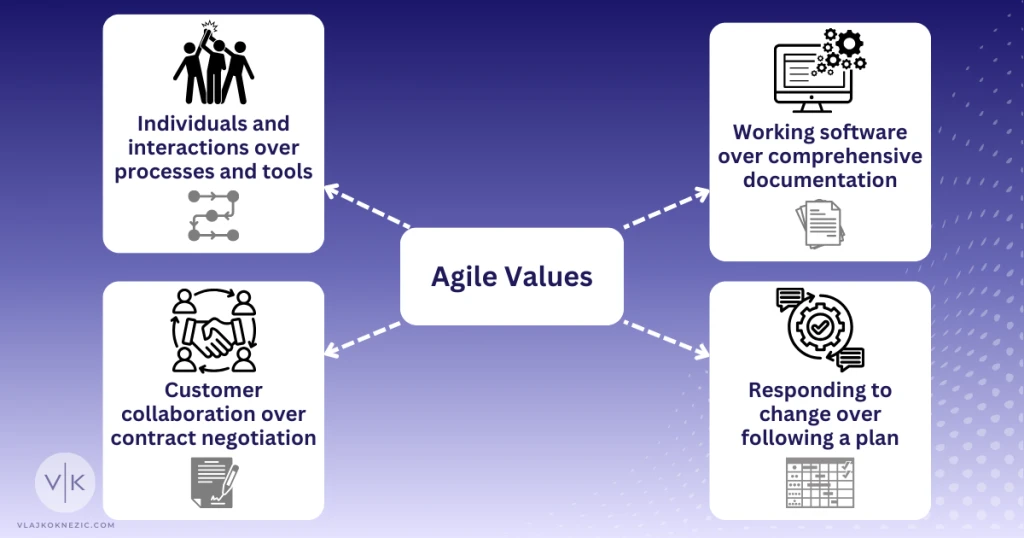
Finally, these values are reflected in 12 principles that inform what it means to be ‘agile’ – notably, flexibility, iterative improvement, and supreme client engagement.
Agile vs Waterfall
Compared with standard project management approaches such as Waterfall (a linear, sequential process with detailed planning up front, then following the plan whether or not it’s working), Agile is more like steering a speedboat: you can turn in no time; you can keep your eye on changing conditions and make mid-course corrections. The team might just spend less time going around in circles.
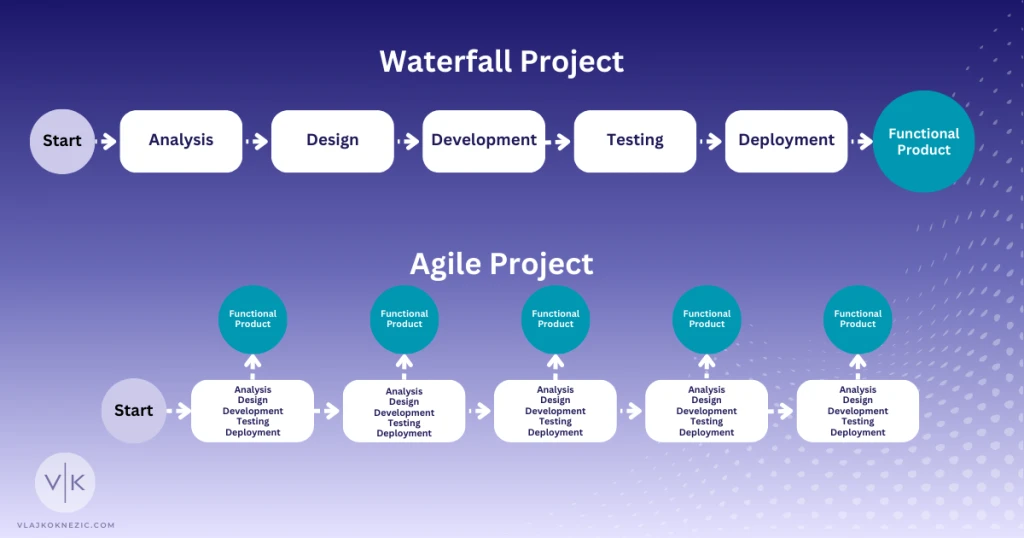
Often, teams using the more traditional approach would keep building a feature that, when it turned out that no one really needed it, had months of work invested in it. That’s the kind of ‘oops’ that Agile is designed to avoid. You make sure that you are checking the compass and making sure you are still pointed at land.
In other words, if you have a rapidly moving problem domain (i.e., people can change their minds at any point about what they want you to do), Agile gives you the means to change what you’re doing quickly. Is it perfect? No. Is it the best we have? I would argue yes. At the very least, it’s a way to deliver value to our product quickly.
The Benefits of Agile Project Management: Why It Works
Do you know why Agile project management has caught on with so many teams, across so many industries, far beyond the confines of the tech world? In the next few minutes, I’ll take you on a tour of the Agile advantages that made it so popular.
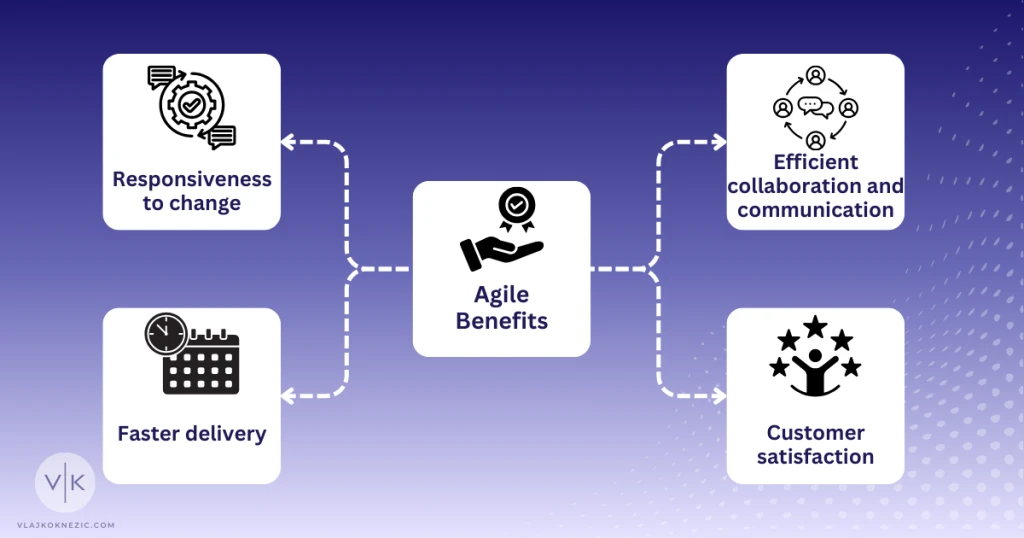
It starts with Agile’s most famous characteristic of adaptability and responsiveness. Say you’re painting a mural, and halfway through, someone tells you that they expect the wall to be knocked down in the next week. You would want to change your approach, wouldn’t you? That is Agile in a nutshell. Teams can respond dynamically to changes in demand: a shifting market, a new strategy from a competitor, or a feedback loop from the most recent sprint review. You are certainly kept on your toes, but you’re always up-to-date for whatever is needed right now, not weeks ago.
Next, collaboration and communication. Agile removes the old school hierarchical lines and has everyone involved rapidly exchanging information. Stand‑ups, sprint reviews, planning meetings, it’s like a group chat, and everyone has a voice. And all this transparency boosts morale and helps to catch problems early, before they impact development. No one is left guessing what others are working on. In an Agile team, the left hand knows what the right hand is doing.
And who doesn’t like faster delivery of their work in the world? You get iterations, so you get faster delivery and the opportunity to improve along the way. Each iteration of work ends with an ‘increment’ – something potentially shippable. It’s like building and improving on the fly rather than at the end. You’re like the gamer who gets constant feedback on how the current strategy is playing out, while adjusting to boost odds of winning.
And finally, the icing on the cake: happier customers. Because Agile engages clients in the process via demos and the iterative refinement of the product, they see their feedback actually implemented almost in real time. This helps build trust and also ensures that what comes out at the other end is actually something you or your clients want and need, not the version of what you ‘wanted’ or had in your mind at the beginning of the project. It’s like having a custom suit made: you tweak as you go to make sure it fits.
Whether you’re a startup founder, a developer or a wedding planner, Agile offers tools that help manage the unpredictability of project work with a little more style and a whole lot less anxiety. Who couldn’t use a bit of that?
Key Agile Frameworks: Choosing the Right Approach
Agile methodology has changed the way projects are managed and products are delivered. There are many different approaches to Agile. In this article, we look at four: Scrum, Kanban, Lean and Extreme Programming (XP). With so many frameworks, it’s hard to know which to use when. This article explains the difference between these four frameworks to help you get a clearer idea of when and how to use them.
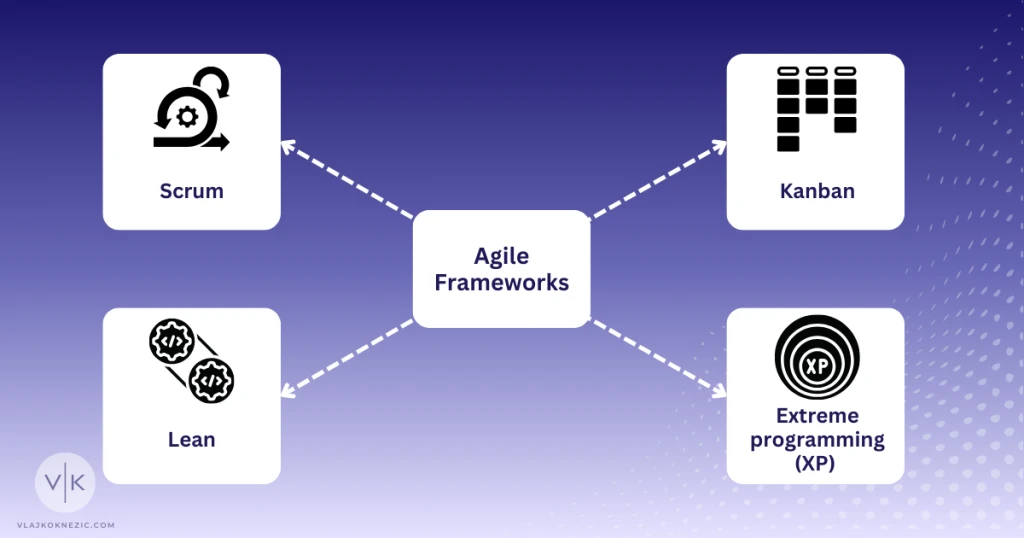
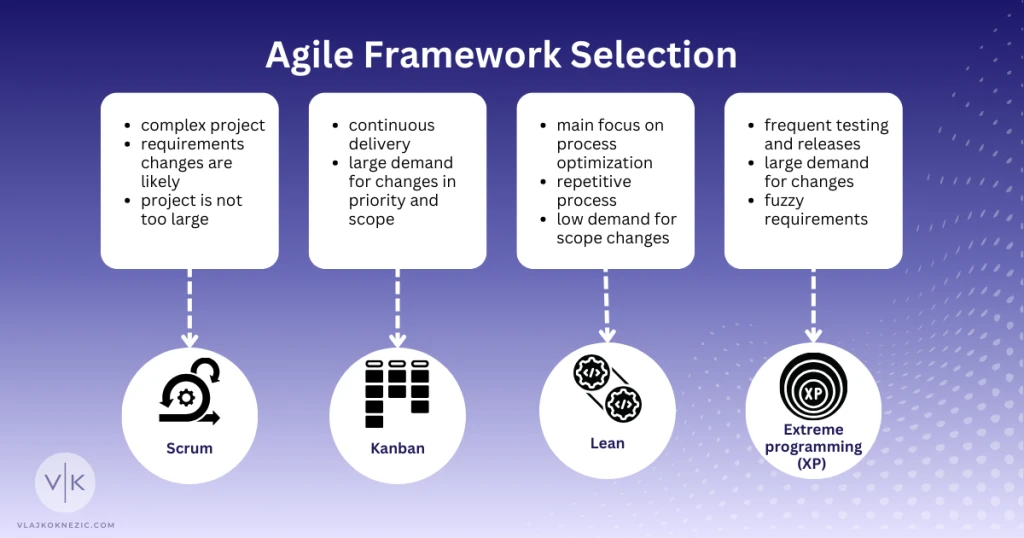
Scrum is best suited to projects that require rapid iterations and are likely to change requirements. It breaks projects down into sprints, which tend to last for two to four weeks, so that plans and deliverables can be adapted to feedback relatively quickly. This makes scrum very rigorous in terms of how it defines team roles, ceremonies and artifacts, which in turn serve to keep the method flexible as it adapts to the changeable needs of the project.
While Kanban is not time-bound, it is focused on the efficiency of the workflow and relies on a visual board for the workflow itself. This is a good methodology for any project where continuous delivery of parts or the whole is required, and where changing priorities are the norm.
Lean methodology is concerned with maximizing customer value while minimizing waste. However, it isn’t just about delivering products faster, but also optimising the processes behind them. Lean can be a great choice for teams ready to focus on producing more and better quality work by identifying and eliminating waste.
Extreme programming (XP) stresses quality software development through frequent testing and releases; it also stresses customer satisfaction by offering continuous delivery of usable software. XP’s iterative approach is particularly appropriate for environments in which requirements for the final product are fuzzy at best and certain to change.
The Right Approach
However, your team needs to choose the appropriate Agile method for its project, team, and goals. If you are doing a complex project, where change is likely, and the project is not too large, Scrum is a good choice. But if your project involves large incoming demand or changing priorities, then Kanban is better. If you need to optimize your process, then Lean is your choice. If your project requires high technical complexity and needs to undergo different kinds of extensive testing, and it’s slotted to last for longer than a year, then XP is an excellent choice.
Furthermore, you don’t have to limit yourself to one; a lot of teams are doing quite well by combining aspects of several methodologies, creating a hybrid, whether it’s combining the flow orientation of Kanban with the time-boxed focus of Scrum to help teams manage workflow while providing a structure for time-bound delivery, or something else altogether. Your success with any integration will depend on your ability to understand the strengths and weaknesses of each methodology and use them to best fit your project and team environment.
You can, nevertheless, put together a strong framework by choosing from these Agile methods (possibly mixing and matching), and staying in line with the requirements of your project goals and with team capabilities.
Implementing Agile in Your Organization: Best Practices
Moving from traditional project management toward an Agile approach can be a transformative journey for any organization. If done correctly, it can lead to becoming a more efficient and effective group. However, the changes are substantial, and there is a certain amount of planning, commitment, and readjustment that needs to take place across your organization to make this happen. The following best practices should help you make the journey successfully.
Steps to Transition from Traditional to Agile Project Management
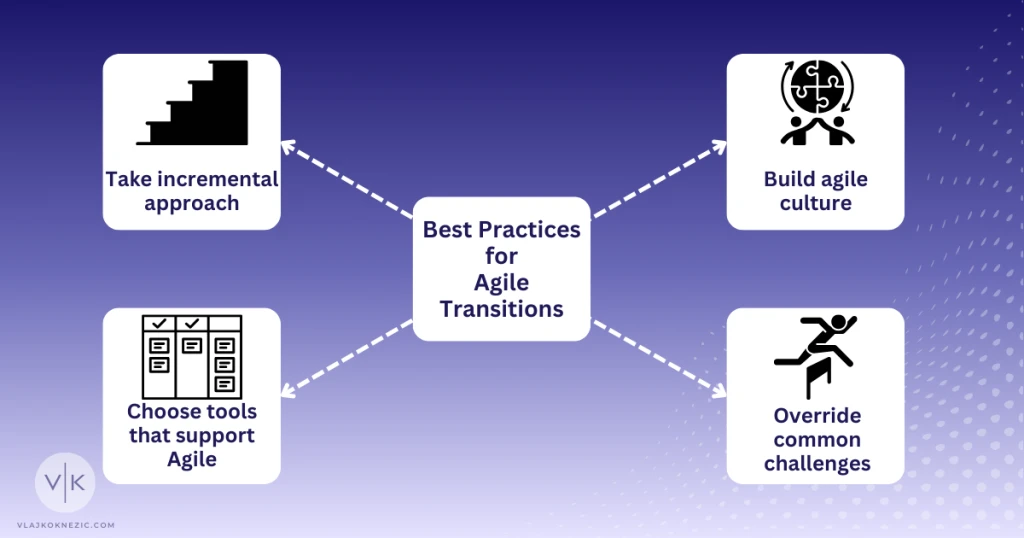
When thinking about how you or your organization can move towards Agile, the best place to start is with a full appreciation of what Agile is and why it is important. Start by ensuring your team and key stakeholders understand Agile and its advantages via workshops, training sessions and pilot projects, and then begin gradually introducing Agile practices into your existing processes. If the organization is relatively small, you could start with a single project or team, and then scale up as you become more experienced and confident.
Building an Agile Culture Within Your Team
While the methodology components of Agile are relatively well understood, Agile is also about culture, about changing mindsets and engagement. Encourage attitudes like collaboration, adaptability and transparency. Help your team change from ‘planning mode’ to ‘change mode’, where they expect change rather than follow a plan. Celebrate failure – when it’s fast, because every failure is also a learning. Encourage teams to make and learn from mistakes as quickly as possible. Encourage feedback all the time and openly. Help your team adapt to the Agile rituals of daily stand-ups, regular sprint reviews and retrospectives, which all help encourage open and continuous communication.
Tools and Technologies to Support Agile Implementation
Choosing the right tools and technologies for an Agile transformation is very important. There are many tools to track, manage and prioritize backlogs, sprints and workflows, such as Jira, Trello or Asana. Additionally, there are various tools to facilitate collaboration such as Slack and Microsoft Teams. It is important to select tools that can easily be integrated into each other and that will suit your specific needs. These tools will not only help you with the day-to-day processes of Agile development but will also help you to track your progress and track the performance of your team.
Overcoming Common Challenges in Agile Adoption
While the benefits of adopting Agile are there for the taking, it does not come without challenges. Some of the most common change obstacles include resistance to change (usually within organizations that have been working in a non-agile manner for a long time), clearing out the backlog, and ensuring quality of deliverables while keeping up with the iterative pace. You can overcome these challenges by communicating and demonstrating the benefits of Agile, providing training, integrating quality assurance processes such as automated testing and code reviews within the sprints, and clearing out the backlog.
It is a strategic decision to transition to Agile, and should be thought through and structured in the same way. By following these best practices, you can make the transition smoother, create an environment that supports Agile, use the right tools to do it more effectively, and address common issues along the way. In doing so, your organization will be more responsive to changing market needs while also improving its success on projects.
Agile Project Management Tools: Your Essential Toolkit
Agile project management calls for nimble tools to match the fluid nature of Agile projects. Whether you’re just getting started with Agile or hoping to upgrade your current set-up, the right tool can dramatically impact your team’s productivity and project outcomes. Below, we guide you through some of the most used tools on the market, as well as features to look out for.
Popular Tools for Agile Project Management
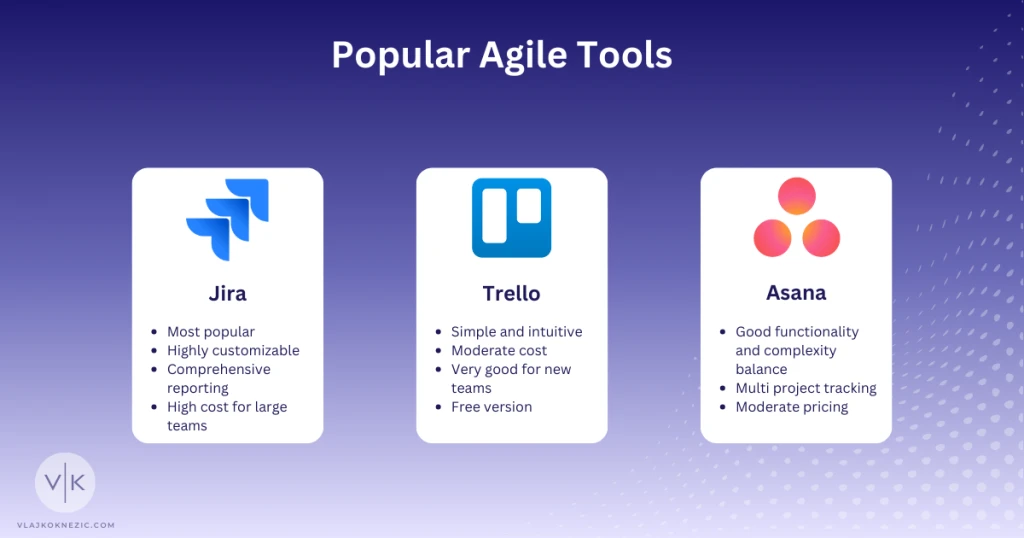
1. Jira: Jira is probably the best-known tool made for software development. The tool’s issue and task tracking capabilities, comprehensive reporting coupled with features for managing sprints and laying out workflows with Kanban and Scrum boards, are particularly strong.
2. Trello: More visual and intuitive than any other tool I’ve ever used, Trello uses cards and boards to organize tasks. One of the simplest tools in the market, this is a good place for a team new to Agile to start.
3. Asana: Asana is a solid middle ground between complexity and functionality. It includes features such as task assignments, timelines, and progress tracking. It can support more than one Agile framework. Because it is one of the few options that is scalable without a huge resource investment, it is also a good fit for those who wish to track multiple projects at once.
Features to Look for in Agile Tools
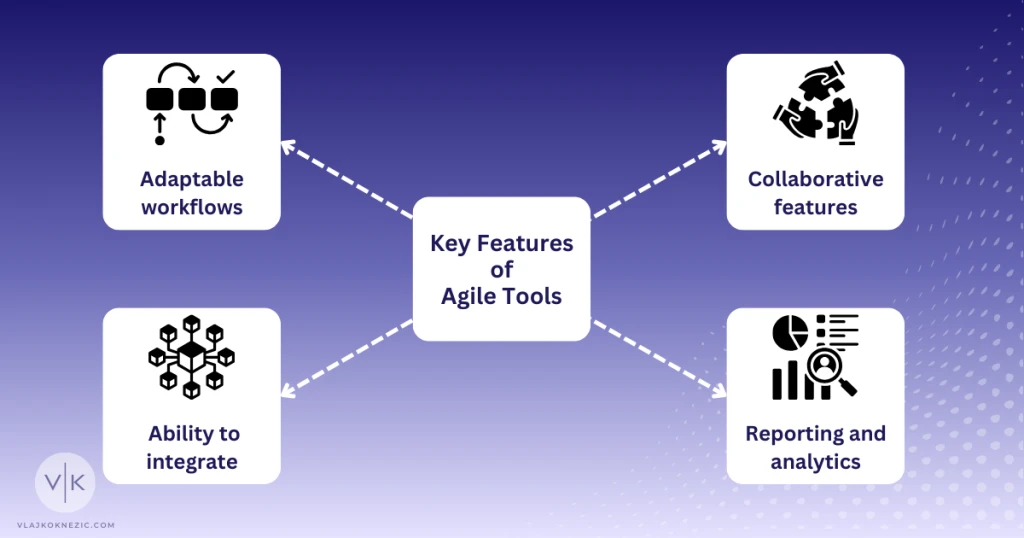
When evaluating Agile tools, consider the following features:
Adaptable workflows: Agile projects can be very different from one another, and being able to tailor workflows to fit your particular process can make all the difference.
Collaborative features: Features that allow a team to collaborate and communicate in real time can help ensure the project trajectory does not become congested or overcrowded.
Ability to integrate: The ability to work well with other tools (such as version control systems, CI/CD pipelines, and communications tools) can help to automate workflows and reduce the need for data entry.
Reporting and analytics: Find out what’s going on: where your team is slacking, where your projects are stuck, where your clients are being neglected. Ideally, you’ll be able to make better decisions based on the insights you gain. At the very least, you’ll be able to tweak your strategy.
How to Choose the Right Tool for Your Team
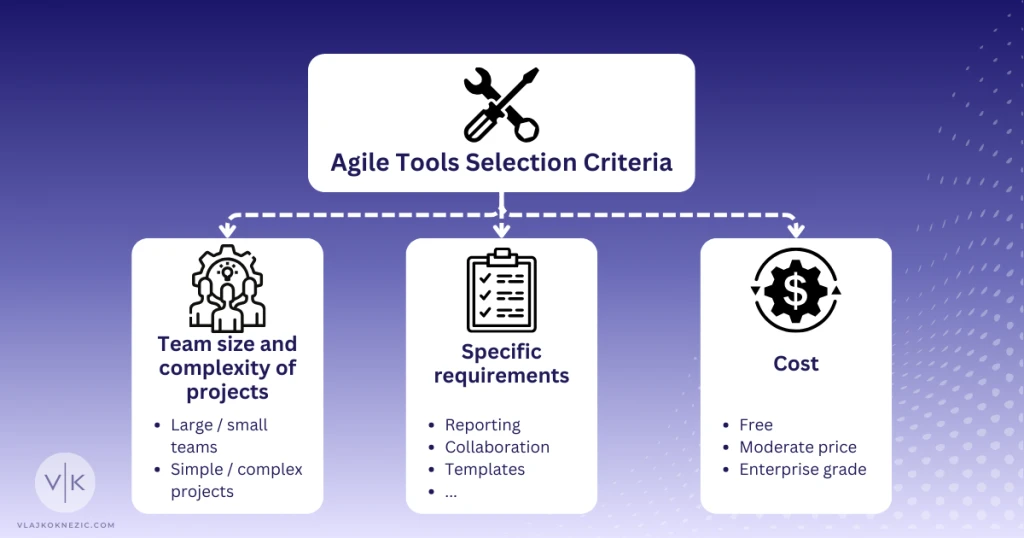
Choosing the right Agile tool depends on several factors:
Team size and complexity of projects: While larger teams with more complex projects might need the functionality of something like Jira, a smaller team or one with a simple project might just need Trello or Asana.
Specific requirements: Think about the concrete challenges you’re looking to address. Are you looking for a better way to visualise tasks? A better report? A better collaboration tool?
Cost: Tools can be free (with limited functionality), enterprise-grade (with lots of bells and whistles), or somewhere in between. Decide what you can afford, and what level of features are really needed for your team to be successful.
When choosing an Agile project management tool, it’s about finding the right balance between features, usability and price. Identifying your team’s exact needs and selecting the most suitable, cost-effective tool for the job will equip your team with a toolbox that will help you get the job done.
Measuring Success in Agile Projects: Metrics That Matter
Because agile projects are dynamic and continuously adapt to change, it’s tough to figure out how to best measure success – especially if you’re just getting started. Selecting and tracking the right KPIs (key performance indicators) is crucial. Here’s a quick breakdown of the right KPIs for agile projects, how to track your progress and yet another reason for using metrics to drive continuous improvement.
Key Performance Indicators (KPIs) for Agile Projects
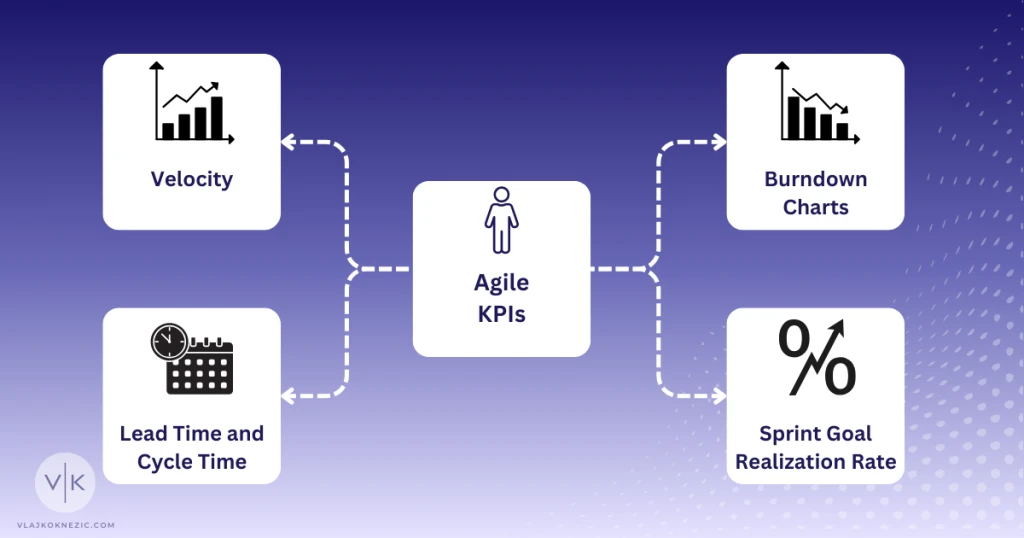
1. Velocity: This is the amount of work the team commits to and completes in a sprint and can be measured in story points or hours. Velocity is used to plan the work for future sprints and can be utilized to determine how much work the team can take.
2. Burndown Charts: These show the amount of work remaining to be completed compared to time. They are the key for knowing if the sprint is within its set targets.
3. Lead Time and Cycle Time: Lead time—the total time from customer request to delivery—and cycle time—the time it takes to finish a job from when the work starts—are key indicators of process efficiency.
4. Sprint Goal Realization Rate: It measures how often your team delivers fully functioning software based on a Sprint Goal decided and defined at the beginning of every Sprint.
How to Track Progress and Measure Outcomes
Effective tracking of Agile projects involves a combination of regular updates and the use of visual tools:
Daily Stand-Ups: a regular meeting at the beginning of each day, where team members update each other on what they did or did not do, what they might do next, and what is blocking them from doing their work.
Agile Dashboards: Customizable dashboards, such as those offered by tools like Jira and Trello, allow for real-time monitoring of team velocity, project pipeline status, team workspace productivity, etc.
Feedback Loops: Regular input from stakeholders and customers ensures that the project aligns with user needs and expectations, and that it is adjusted accordingly.
Using Metrics to Drive Continuous Improvement
What really matters about these metrics in Agile projects is how they drive improvement and how to make it happen.
Retrospectives: Use the information collected during sprints in the retrospective meetings to see what went well and what did not and how the current process can be optimized for better efficiency on the next sprint.
Feedback: Metrics inform and should lead to decisions or actions. For example, persistently low velocity could indicate that tasks are too complex or not well defined and that the team’s backlog grooming practices need to be reviewed.
Future Planning: Using historical data for forecasting, sets realistic performance targets for future work.
By paying attention to metrics that directly reflect the efficiency and effectiveness of Agile practices, the team will not only promote their projects’ timely progress, but also dynamically improve the process itself throughout the development. This should not only save time but it will also improve the quality of the work being produced, making the agile team ready to respond to changing project specifications or market needs.
Real-World Examples of Agile Project Management in Action
The following is a series of examples illustrating where Agile has worked and where it has not, and some tips for applying Agile principles across different sectors.
Case Studies of Successful Agile Implementations
1. Software Development: Spotify, a music streaming service, originally adopted an Agile model that gives teams a high degree of autonomy and alignment when building products. They structured their organization into ‘squads’ – each squad resembling a mini-startup within the company, which has allowed them to scale rapidly while maintaining innovation and accountability.
2. Automotive Industry: Tesla Motors is using agile principles to improve vehicle design and manufacturing processes. This allows for iterative design and rapid refinement of vehicle upgrades, which ultimately leads to better product quality and customer satisfaction.
3. Banking Sector: Following a huge Agile transformation, ING, a global bank, reorganized around cross-functional team structures, which allowed the bank to develop products and offer services faster.
Lessons Learned from Real-World Agile Projects
From these examples, several key lessons emerge:
Empower Your Teams: When you give teams the authority to decide on their own and to solve problems themselves, it helps to motivate them more, and the end results can be better.
Maintain Customer Focus: Incorporate user feedback findings and data into the development process on an ongoing basis to keep the product aligned with end-user requirements and expectations.
Adapt Governance: Most management styles are ultimately top-down and command and control, which is not compatible with Agile. A more adaptable governance model can help you innovate and become more responsive.
Tips for Applying Agile Principles in Various Industries
Agile isn’t just for the tech world, after all. Here’s how different industries can apply Agile principles:
Construction: Ensure projects are on track by holding daily stand-ups and taking near-instant action when changes are required, such as when issues arise. Iterative planning can help teams adapt to changes in project scope or requirements.
Healthcare: Agile can help surpass patient care to build the next generation of life-saving apps or adapt new therapies and treatments quickly and fluidly. Teams can stay nimble to react quickly to changing healthcare technologies and innovations. Agile creates a faster, more responsive healthcare system by making it easier for departments to work together.
Education: Agile can help in curriculum development by allowing educators to iteratively develop teaching methods and materials based on student feedback and learning outcomes.
These examples from the real world confirm the view that Agile isn’t just a methodology but a mindset. It is possible, under the right circumstances, to apply the principles of Agile – emphasising flexibility, cross-functional interplay and experimentation – to help almost any industry function more efficiently and effectively, from tech companies to hospitals to schools and colleges.
Agile project management isn’t just a trend; it’s the way forward for teams that want to stay competitive and deliver exceptional results.