The Essentials of Agile Capacity Planning: A Comprehensive Guide
Table of Contents
Introduction #
Agile Capacity Planning is the heartbeat of any Agile project, pumping rhythm and predictability into the chaotic nature of project management. It helps teams determine the amount of work they can undertake in a whole project and any given iteration, striking a balance between underutilization and overloading.
With this type of planning, you can answer critical questions like, “How much can we realistically achieve in the next sprint?” or “What’s the optimum workload that ensures efficiency without overwhelming the team?”
It brings transparency and realism into the planning process, significantly reducing the risk of project failure due to over-commitment or misallocation of resources.
Agile Capacity Planning is not just a fancy term or an optional add-on. It’s a powerful tool that can transform unpredictability into predictability, chaos into order, and dreams into achievable goals.
In the following sections, we will explain the benefits, key elements, implementation steps, best practices, and common challenges of Agile Capacity Planning. So, whether you’re new to Agile or an experienced practitioner, stay with us as we start exploring.
What is Agile Capacity Planning #
Before we set sail into the nitty-gritty of planning, we must anchor our understanding of what it truly means. In its simplest form, it is a strategic process that determines the amount of work an Agile team can handle in a given iteration or sprint. It is built on the following:
- empirical data
- realistic expectations
- deep understanding of the team’s capabilities
It’s not about cramming in as much work as possible into a sprint but rather about optimizing productivity and ensuring a sustainable work pace.
Capacity planning in agile projects is rooted in the values and principles of Agile. It focuses on delivering the highest-value work sustainably, promoting efficiency, flexibility, and continual improvement. It plays a crucial role in maintaining a project’s pace, minimizing the risk of overcommitting, and setting realistic stakeholder expectations.
Agile Planning vs Traditional Planning #
But how does this type of planning differ from traditional planning methodologies? The answer lies in a fundamental shift of perspective.
Traditional planning methodologies, such as Waterfall, hinge on a deterministic approach. In this model, a comprehensive plan is created at the beginning of the project, and deviations are not welcomed. This leads to cramming in as much work as possible without adequate consideration for the team’s real capacity and inevitable future disruptions, leading to overcommitment, burnout, and, ultimately, project failure.
On the other hand, Agile Capacity Planning is all about embracing uncertainty and change. It recognizes that plans made at the start of a project will likely need to be adjusted as new information emerges. It offers a more dynamic and flexible approach, enabling teams to plan their work based on actual capacity rather than best-case scenarios. In essence, it replaces wishful thinking with realism, providing a more accurate and reliable way to plan and execute work.
As we progress in this guide, we’ll delve deeper into the benefits of Agile Capacity Planning, its key elements, and how you can implement it in your projects.
Benefits of Agile Capacity Planning #
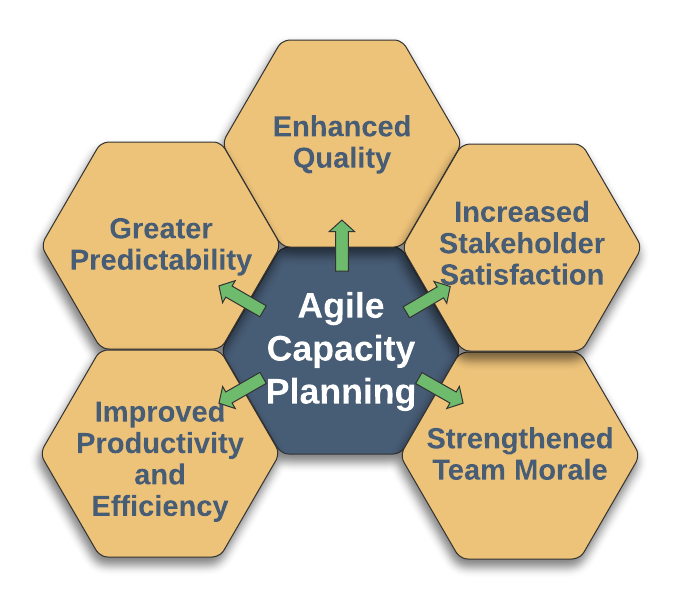
Agile Capacity Planning can transform the landscape of your project management endeavors by infusing it with predictability, efficiency, and sustainability. This practice allows you to translate the potential of Agile methodology into tangible outcomes and measurable successes.
Let’s look into some of the compelling benefits this approach brings to your projects.
1. Improved Productivity and Efficiency #
By understanding your team’s actual capacity, you can ensure that work is allocated effectively, minimizing the risk of overburdening or underutilizing team members. This promotes a sustainable pace of work, enhancing the overall productivity and efficiency of the team.
2. Greater Predictability #
Teams can provide more accurate estimates for task completion, thus increasing the predictability of project timelines. It replaces hopeful guesswork with data-driven insights, creating a sense of reliability and trust among stakeholders.
3. Enhanced Quality #
Avoiding over-commitment helps maintain a steady, sustainable work pace, reducing the risk of rushed work or overlooked errors. It ensures that the team has sufficient time to focus on the quality of work, leading to superior outputs.
4. Increased Stakeholder Satisfaction #
Realistic planning helps set realistic expectations for project stakeholders. Providing a clearer view of what can be achieved within a given time frame increases transparency and aids in aligning stakeholder expectations with the team’s capabilities.
5. Strengthened Team Morale #
Nothing drains a team’s energy more than constantly feeling overwhelmed with work. This approach to planning keeps the workload manageable, helping to maintain high morale and motivation among team members.
As we go deeper into this guide, we’ll explore how to implement Agile Capacity Planning effectively by addressing potential pitfalls and revealing invaluable tips. Whether you’re a start-up, a multinational corporation, or something in between, Agile Capacity Planning can be your secret weapon for project success. The benefits it brings are not just theoretical concepts; they are practical, achievable, and within your reach.
Key Elements of Agile Capacity Planning #
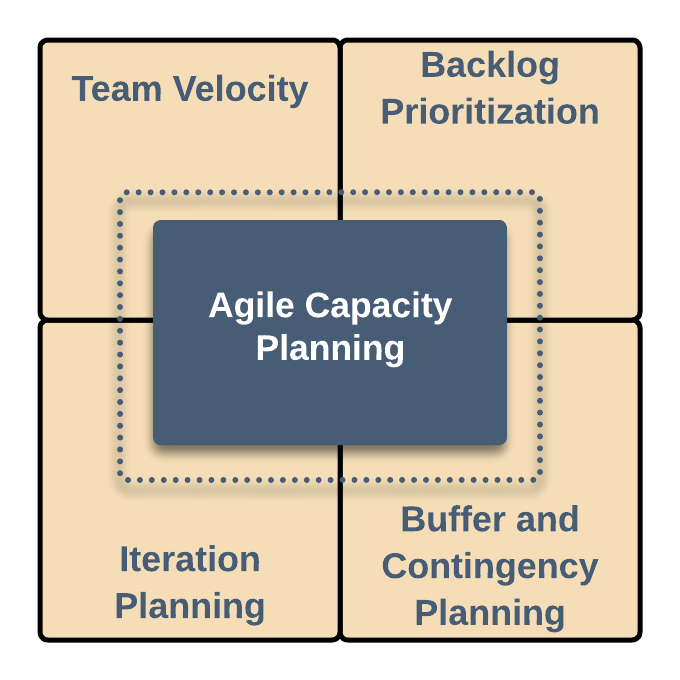
Unlocking the full potential of Agile Capacity Planning requires a solid grasp of its foundational elements. Like a compass guiding you on an uncharted voyage, these elements serve as critical reference points in your planning journey.
1. Team Velocity #
In Agile, ‘velocity’ is a critical term that denotes the amount of work a team can complete in a single iteration or sprint. It measures your team’s capacity, usually calculated using story points based on past performance. Understanding your team’s velocity is critical to knowing how much work a scrum team or any other agile team can do.
2. Backlog Prioritization #
In Agile methodology, the backlog is the comprehensive list of tasks or user stories that need to be addressed in a project. However, not all tasks are created equal. Some are critical for project success, while others can be deferred without significant impact. Backlog prioritization helps identify the highest-value tasks that should be addressed in the upcoming sprint, ensuring that your team’s efforts are directed where they can deliver the most impact.
3. Iteration Planning #
Iteration or sprint planning is the process of deciding which tasks from the prioritized backlog should be included in the next sprint, based on the team’s velocity. It’s about setting a realistic and achievable goal for the upcoming sprint, fostering a sense of commitment and purpose within the team.
4. Buffer and Contingency Planning #
In the real world, things don’t always go according to plan. Unexpected events can throw a wrench in the most meticulously laid plans. This is where buffering and contingency planning come into play. A buffer is an amount of time set aside to accommodate unexpected events or tasks that take longer than anticipated. It’s the safety net that catches you when the unpredictable happens, helping to maintain the rhythm of your project despite unexpected setbacks.
Taken together, these four elements form the beating heart of Agile Capacity Planning. Understanding and effectively managing these aspects can make the difference between a successful project and one that veers off course. In the upcoming sections, we’ll delve deeper into how to implement Agile Capacity Planning, and how to overcome common challenges that may arise along the way.
Steps to Implement Agile Capacity Planning #
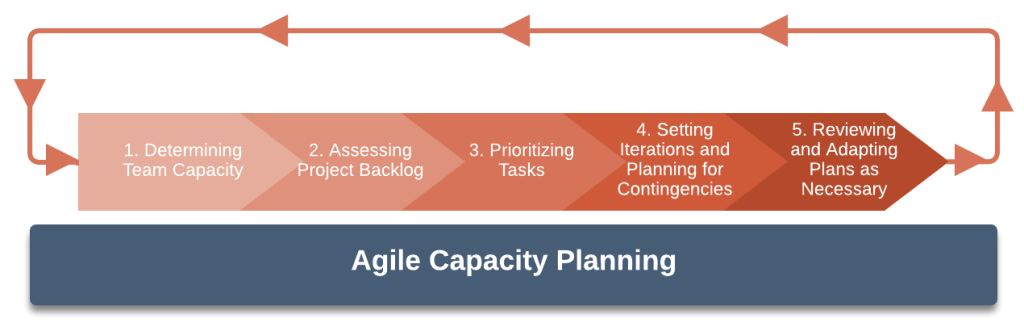
Embracing Agile Capacity Planning requires more than just understanding its benefits and key elements. It involves a systematic approach to implementation, and when executed correctly during project planning, it can transform your project’s trajectory toward success.
All agile teams must do it, and it is the responsibility of the scrum master to ensure it is done. Here’s a step-by-step guide on how to implement Agile Capacity Planning in your project.
1. Determining Team Capacity #
The first step is to understand your team’s capacity. This process begins by calculating the team’s velocity—the average amount of work the full team was able to complete in previous sprints.
Once the velocity is known, it is possible to calculate the capacity for each sprint by considering team member availability. If only half of the team can work in a sprint, then only half of the velocity can be accomplished, and that must be accounted for in the sprint planning meeting. Through effective capacity planning, you set realistic boundaries for what can be achieved within a project timeline.
2. Assessing Project Backlog #
Once you know your team’s capacity, the next step is to assess your project backlog. The backlog is a list of all tasks or user stories that need to be accomplished for the project. All items in the backlog should have an effort estimate based on the best guess and expressed in story points. An accurate, well-organized backlog gives you a comprehensive view of the work ahead. Having a solid backlog is essential for both project planning and future sprint planning.
3. Prioritizing Tasks #
With your backlog ready, it’s time to prioritize tasks. Not all tasks hold the same value or urgency. Some tasks, if completed earlier, can deliver significant value or reduce project risk. Others may depend on external factors or be less impactful to the project’s overall progress. Prioritizing tasks helps ensure your team’s efforts are directed towards the most valuable and critical work in each sprint.
4. Setting Iterations and Planning for Contingencies #
Now that you have your prioritized tasks and understand your team’s capacity, you can plan your iterations. Select tasks from the top of your prioritized backlog that fit into your team’s capacity, taking care not to overcommit.
Remember, life happens. No matter how well we plan, unexpected events can and will occur. It’s essential to plan for contingencies by building buffers into your iterations. These buffers will absorb the impact of unforeseen events and help keep your project on track.
5. Reviewing and Adapting Plans as Necessary #
Agile planning is not a ‘set it and forget it’ strategy. It thrives on feedback and adaptation. As each iteration ends, review your team’s performance, gather learnings, and adapt your future plans as necessary. This continuous review and adaptation cycle is what keeps agile planning dynamic, realistic, and effective in dealing with the challenges of delivering complex projects.
Implementing Agile Capacity Planning may seem daunting at first glance. Still, with these systematic steps, you can infuse your projects with a level of predictability, flexibility, and efficiency previously unimaginable.
Best Practices for Agile Capacity Planning #
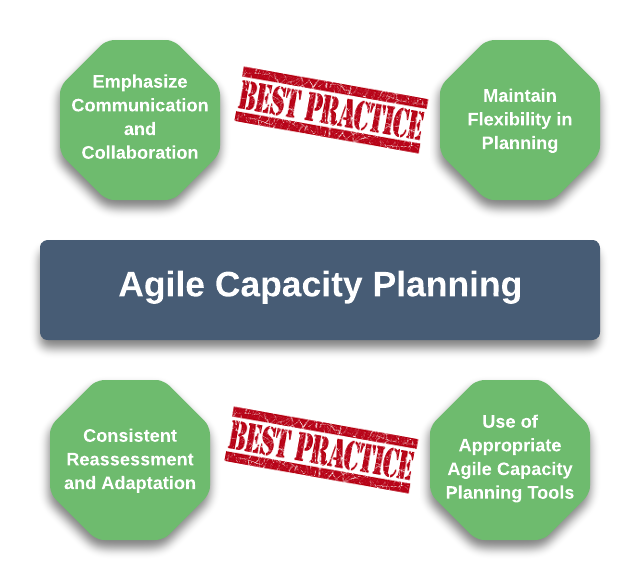
Knowing the best practices for Agile Capacity Planning can help you steer your projects through uncertainty and change. Here are some key strategies that can enhance the effectiveness of the capacity management of a scrum team.
1. Emphasize Communication and Collaboration #
Agile Capacity Planning is not a solitary activity. It thrives on open communication and collaboration. Regularly engage with your team members, stakeholders, and anyone involved in the project. Ensure that everyone understands their roles, responsibilities, and the project’s objectives. Collaborative planning sessions in agile teams can lead to better understanding, commitment, and accountability, ultimately leading to proper capacity planning.
2. Maintain Flexibility in Planning #
Agile, at its heart, is about embracing change. While it’s essential to have a plan, maintaining flexibility is key. Understand that priorities may shift, new requirements may emerge, and unforeseen challenges may surface. Be prepared to adjust your plan as necessary, always keeping your team’s capacity and the project’s goals in sight.
3. Consistent Reassessment and Adaptation #
One of the powerful features of Agile is its emphasis on continuous improvement. Don’t make the mistake of thinking that once a plan is set, it’s set in stone. Consistently reassess team member’s availability, the total capacity of your scrum teams, and spirit plans, reflect on what’s working and what isn’t, and adapt as necessary. Use each iteration as a learning opportunity to refine your future planning.
4. Use of Appropriate Agile Capacity Planning Tools #
While capacity based planning can be carried out manually, numerous tools can facilitate and streamline the process. These tools can aid in everything from backlog management and prioritization to tracking team velocity and visualizing progress. Tools like Jira, Trello, or Rally can significantly enhance your planning process. However, remember that tools are meant to facilitate the process, not dictate it. The ultimate success of any planning depends on the people using these tools and the practices they follow.
Incorporating these best practices into your project and sprint planning sessions can exponentially increase effectiveness, transforming your project management process into a well-oiled, high-performing machine.
Challenges in Agile Capacity Planning and How to Overcome Them #
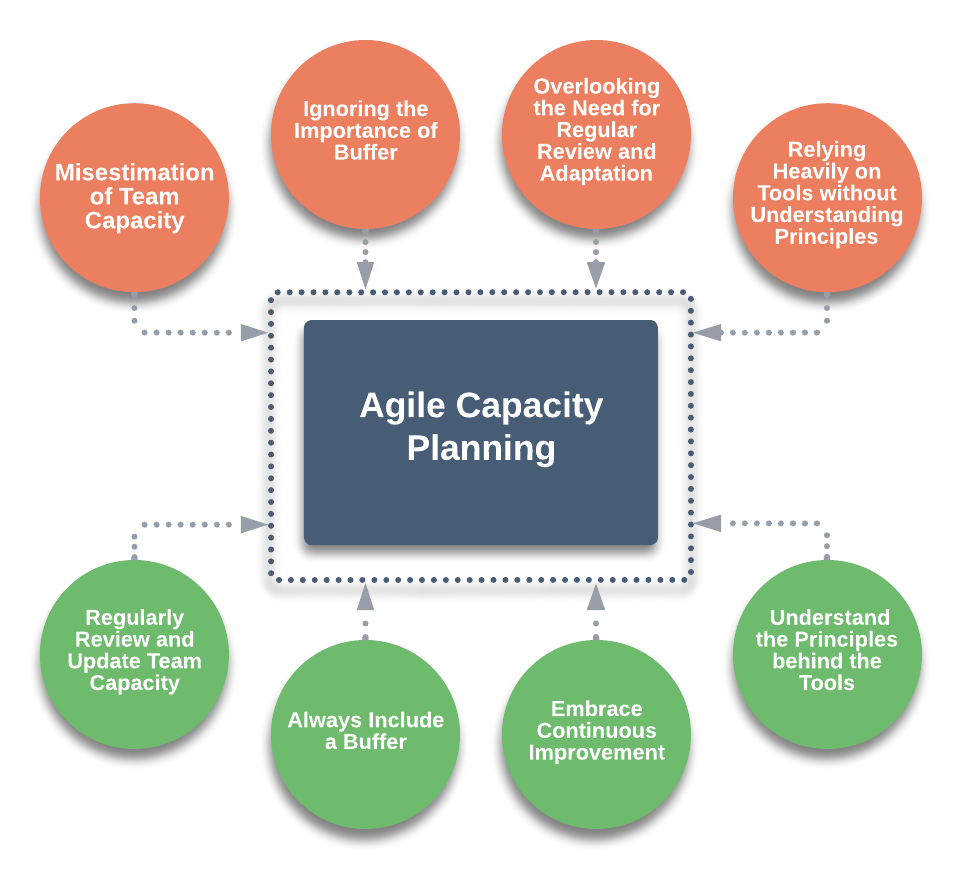
While Agile Capacity Planning offers many benefits, it’s not without its challenges. Recognizing and knowing how to overcome these challenges is vital to ensuring smooth and successful project execution.
Common Pitfalls in Agile Capacity Planning #
1. Misestimation of Team Capacity #
One common pitfall is misestimating development team capacity. Overestimating your team’s capacity can lead to unrealistic expectations, burnout, and project delays, while underestimating can result in idle resources and delayed value delivery.
2. Ignoring the Importance of Buffer #
Another common mistake is neglecting to account for a buffer or contingency in planning. Agile projects are not immune to unexpected disruptions, and not having a buffer can derail your plans.
3. Overlooking the Need for Regular Review and Adaptation #
Effective capacity planning is not a one-time activity; it’s a continuous process. Overlooking the need for regular review and adaptation can lead to stagnant plans that are not reflective of current realities.
4. Relying Heavily on Tools without Understanding Principles #
While tools can be valuable aids in capacity based sprint planning, relying heavily on them without understanding the underlying principles and practices can lead to ineffective planning and execution.
Practical Tips and Strategies to Mitigate Capacity Planning Challenges #
1. Regularly Review and Update Team Capacity #
To avoid misestimating team capacity, regularly review and update your understanding of it. Use historical data and consider factors such as development team members leave, training, team holidays, national holidays, and other non-project activities. Remember, capacity is not static; it changes with time and circumstances.
2. Always Include a Buffer #
Ensure you always include a buffer in your iterations to accommodate unexpected disruptions or tasks taking longer than anticipated. It’s better to finish early than to be constantly racing against time.
3. Embrace Continuous Improvement #
Review and adaptation should be integral to your Agile Capacity Planning. Regularly review your plan, reflect on what’s working and what’s not, learn from each iteration, and adapt your future plans as necessary.
4. Understand the Principles behind the Tools #
While tools can be valuable aids in Agile Capacity Planning, it’s important to understand the principles and practices they are built upon. Tools should facilitate the process, not become the process. Invest time in understanding Agile Capacity Planning principles, and use tools to support these principles, not replace them.
Capacity based planning may be complex. Still, with awareness of potential pitfalls and armed with strategies to overcome them, you can confidently steer your projects toward success. Remember, every challenge is an opportunity for growth and learning, and regardless of whether you are a scrum master, a product owner, or a developer, embrace them and learn from them.
Further Resources #
Mastering Agile Capacity Planning is a rewarding journey, but there’s always more to learn. The field continues to evolve, with new practices and insights being developed constantly. To help you continue your learning journey, here’s a collection of valuable resources, including books, articles, and online courses.
Books #
- “Agile Estimating and Planning” by Mike Cohn - This book provides a comprehensive view of planning for Agile projects and gives practical strategies for estimating and planning project scope, duration, and cost in an Agile context.
- “The Art of Agile Development” by James Shore and Shane Warden - A detailed exploration of Agile development, this book includes sections on planning, estimating, and other topics related to Agile Capacity Planning.
- “Essential Scrum: A Practical Guide to the Most Popular Agile Process” by Kenneth S. Rubin - This book provides a deep dive into Scrum, one of the most popular Agile frameworks, and includes a focus on capacity planning and estimating in a Scrum context
Articles #
- “Agile Capacity Planning 101: Theory + Tools” by Libby Marks - A concise and practical guide to Agile Capacity Planning.
- “How To Plan Capacity of Agile Projects in Practice” by Sam Barnes - This article offers some handy tips for effective Agile Capacity Planning.
Online Courses #
- “Atlassian Jira and Scrum Fundamentals for Beginners” on Udemy (“80% off” discount coupon included) - This course delves into Agile planning and estimating techniques, including capacity planning.
- “Agile Project Management” on edX - This course provides a broad overview of Agile Project Management and includes sections on Agile planning and estimating.